
AI is moving fast. Every few months, a new model, tool, benchmark, demo, or product category appears. The language around AI also changes quickly: chatbots, copilots, agents, agentic workflows, autonomous systems, AI teammates.
It is easy to get excited. It is also easy to mistake excitement for direction.
Agentivium AI was created from a different starting point. We are not interested in treating AI agents as magic. We are interested in a harder question:
What does it take for AI agents to become useful, accountable, resource-aware, and sustainable parts of real-world systems?
This question did not come from hype. It came from working with systems.
Before Agentivium AI, our background was shaped by high-performance computing, research software, student communities, AI workloads, and practical engineering environments where systems must be scheduled, monitored, debugged, constrained, and improved over time. In such environments, a system is not considered good simply because it produces an impressive answer once. It must work repeatedly. It must expose what happened. It must respect resources. It must fail in ways people can understand. It must create measurable value.
The rise of AI agents makes this systems perspective more important, not less.
OpenAI describes agents as systems that can independently accomplish tasks on behalf of users, and its 2025 agent-building tools reflect a broader industry shift from single-turn chat interfaces toward systems that can use tools, handle multi-step work, and operate more reliably in real applications.[1] Microsoft also framed 2025 as “the age of AI agents,” pointing toward a web and software ecosystem where agents can act across contexts, tools, and organizations.[3] IBM similarly defines AI agents as systems capable of autonomously performing tasks on behalf of users or other systems, including decision-making, problem-solving, interaction with environments, and action execution.[5]
These are strong signals that agents are not just another chatbot feature. But they also reveal the real problem: if agents can act, then they must be designed, governed, evaluated, and integrated as operational actors.
That is where Agentivium AI begins.
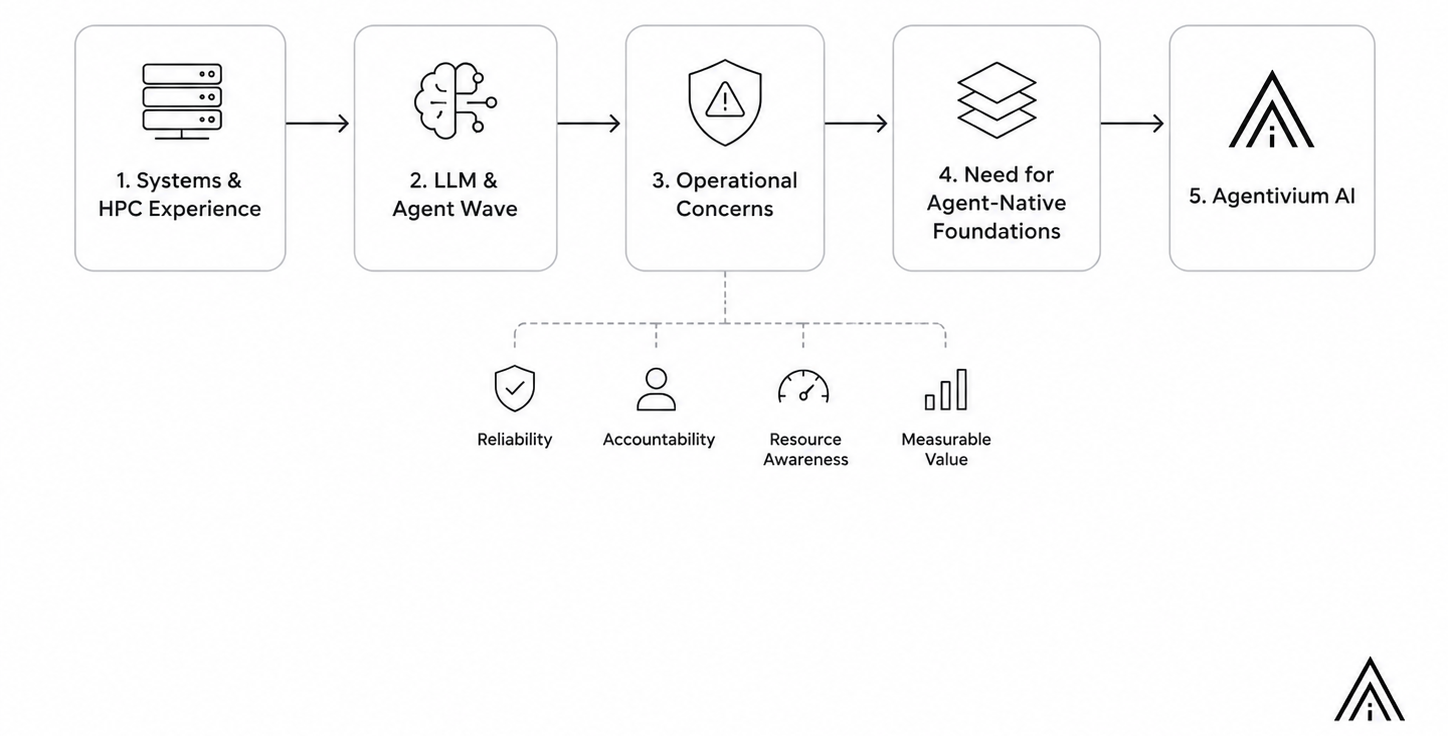
From systems-building experience through the LLM and agent wave to the need for agent-native foundations.
From AI Excitement to System Responsibility
The current AI wave is real. Modern models can reason better, use tools, write code, analyze documents, interact with software interfaces, and coordinate multi-step tasks. Research systems such as Agent S show that agents can interact with graphical computer interfaces and perform complex computer-use tasks through planning, experience retrieval, and agent-computer interfaces.[7] Recent work on software engineering agents also shows that AI agents are already changing how code is produced, reviewed, and integrated in real repositories, while still exposing a trust and utility gap.[9]
This is why dismissing agents as hype would be a mistake.
But accepting every agent demo as the future would also be a mistake.
Many agent systems look powerful in demos because the task is narrow, the environment is controlled, and the cost of failure is low. Real environments are different. A real system has users with changing intent, data with uncertain quality, policies that constrain action, budgets that limit compute, and consequences when actions are wrong. A real system also has memory, history, context, ownership, latency, privacy, and accountability.
This is the gap Agentivium AI is concerned with: the gap between impressive agent demos and dependable agent-native systems.
Anthropic’s guidance on building effective agents is useful here because it warns against unnecessary complexity. It distinguishes structured workflows from more autonomous agents and recommends starting with the simplest effective design before adding more autonomy.[2] This view aligns strongly with Agentivium AI’s philosophy: more autonomy is not automatically better; more agents are not automatically better; more compute is not automatically better.
The real goal is not maximum autonomy. The real goal is useful, grounded, and measurable action.
Why “Agent-Native,” Not Just “Agentic”?
We use the term agent-native deliberately.
“Agentic” usually describes the behavior of an AI system. An agentic system can reason, plan, use tools, decompose tasks, collaborate with other agents, remember context, and take actions. Academic work has started to clarify distinctions among AI agents, agentic AI, and multi-agent systems, often emphasizing autonomy, orchestration, memory, and dynamic task decomposition.[6]
That language is useful, but it is still mainly centered on what the AI can do.
“Agent-assisted workflow” is also useful, but narrower. It describes a familiar workflow improved by AI assistance: writing an email, summarizing a document, generating code, searching information, preparing a report, or automating part of a business process. This is practical and valuable, but it still treats AI as a layer added on top of existing workflows.
Agentivium AI is interested in a deeper shift.
Agent-native means designing systems from the beginning for a world where humans, agents, tools, data, memory, policies, evidence, and compute infrastructure interact continuously.
-
In an agent-assisted workflow, the human workflow comes first and AI helps.
-
In an agentic system, the agent’s capability comes first and the system is built around what the agent can do.
-
In an agent-native system, the whole environment is designed for human-agent-system cooperation from the start.
This distinction matters because agents are not merely better interfaces. When agents can decide, call tools, generate actions, consume compute, modify state, and influence people, they become part of the operating fabric of a system. They need traces. They need evidence. They need policies. They need evaluation. They need cost awareness. They need human oversight. They need mechanisms for learning from what happened before.
That is why Agentivium AI does not simply ask:
How do we build smarter agents?
We ask:
What foundations are needed for agents to become responsible participants in real systems?
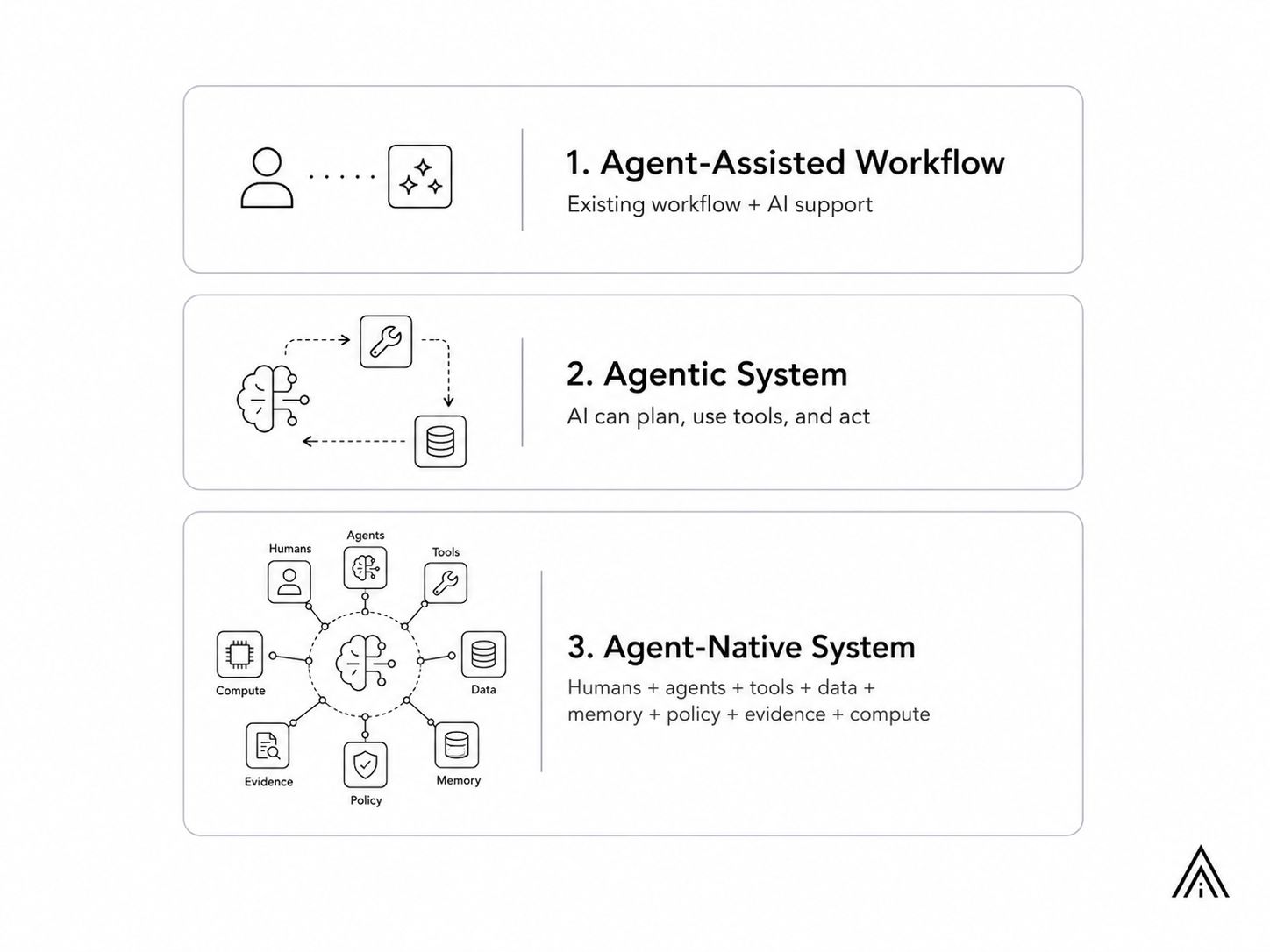
Agent-assisted workflow, agentic systems, and agent-native systems compared.
The Origin of Agentivium AI
Agentivium AI began as a response to a recurring observation: many AI projects can produce impressive outputs, but fewer can explain how those outputs should become reliable parts of real systems.
This observation appeared across different domains.
-
In learning systems, AI can generate exercises, feedback, and study plans. But without a meaningful model of the learner’s evolving state, it is difficult to know whether a recommendation is appropriate, timely, or useful.
-
In agriculture and real-world storytelling, AI can generate narratives. But without traces, evidence, and domain context, a story can become generic content rather than a grounded representation of real growth, care, harvest, and value.
-
In smart environments, AI can suggest or control actions. But when physical devices, sensors, rooms, and people are involved, the problem is no longer just intelligence. It becomes a question of policy, safety, local context, and human approval.
-
In HPC and AI infrastructure, agents can be treated as workloads. They consume tokens, GPUs, memory, time, APIs, tools, and human attention. Once agents become workloads, they must be scheduled, observed, budgeted, and evaluated.
These domains look different on the surface. But underneath them is the same question: how do we build systems where digital state, event history, evidence, adaptive action, policy, and compute awareness work together?
This is the reason Agentivium AI exists.
It is not a chatbot company. It is not a smart home app. It is not an agriculture storytelling app. It is not only an HPC scheduling project. It is not a collection of student demos.
Agentivium AI is a research-engineering initiative for building reusable foundations for agent-native systems, validated through real-world testbeds. This is also the current internal positioning of Agentivium AI: Agentivium Core defines reusable modules and principles, while testbeds apply them in real domains and contribute data, schemas, edge cases, and operational knowledge back to the Core.
What Agentivium AI Stands For Today
Agentivium AI stands for a disciplined way of thinking about the next stage of AI systems.
-
First, we believe agent-native systems must be grounded. Important outputs and actions should be connected to evidence, context, traces, or domain knowledge. A system that cannot explain why it acted is difficult to trust.
-
Second, we believe agent-native systems must be accountable. When agents act on behalf of people or organizations, there must be a way to inspect decisions, replay events, identify failures, and improve behavior.
-
Third, we believe agent-native systems must be resource-aware. Agents are not free. They consume tokens, compute, storage, latency, APIs, energy, and human attention. Research on efficient agents shows that agent systems face real trade-offs between effectiveness and cost, and that additional complexity can produce diminishing returns.[8]
-
Fourth, we believe agent-native systems must be policy-aware. It is not enough to filter the final answer. Policies should shape what the agent is allowed to plan, access, execute, store, and escalate.
-
Fifth, we believe agent-native systems must create measurable value. The point is not to create the most autonomous system. The point is to create useful outcomes per unit of action, attention, and compute.
This is why Agentivium AI’s direction is not “AI everywhere.” It is closer to:
minimum necessary intelligence, grounded in evidence, operating under constraints, creating measurable value.
From agent-native foundations to Agentic Computing research
Agentivium AI now organizes its public research around Agentic Computing as an emerging field, with agent-native systems as a design principle and systems and infrastructure as the technical focus.
Our active threads are Agentic Execution Models; Agentic Runtime & Resource Management; and Agentic Memory & Inference Systems. Applied environments and supporting assets remain useful when they let us test a mechanism under real constraints, but they are not presented as equal product pillars.
The research method is deliberately concrete:
classical systems mechanism
→ changed workload assumption
→ adapted mechanism
→ implementation
→ benchmark and reproducibility
The long-term value of Agentivium AI is not one app. It is the discipline, infrastructure, and reusable knowledge needed to build many agent-native systems responsibly.
This is also why students working with Agentivium AI should not think of their work as isolated demos. A student project may contribute to a workload model, runtime prototype, benchmark, trace, evaluation rubric, design note, or other reusable artifact.
That is how a bounded contribution becomes part of a cumulative research-engineering program.
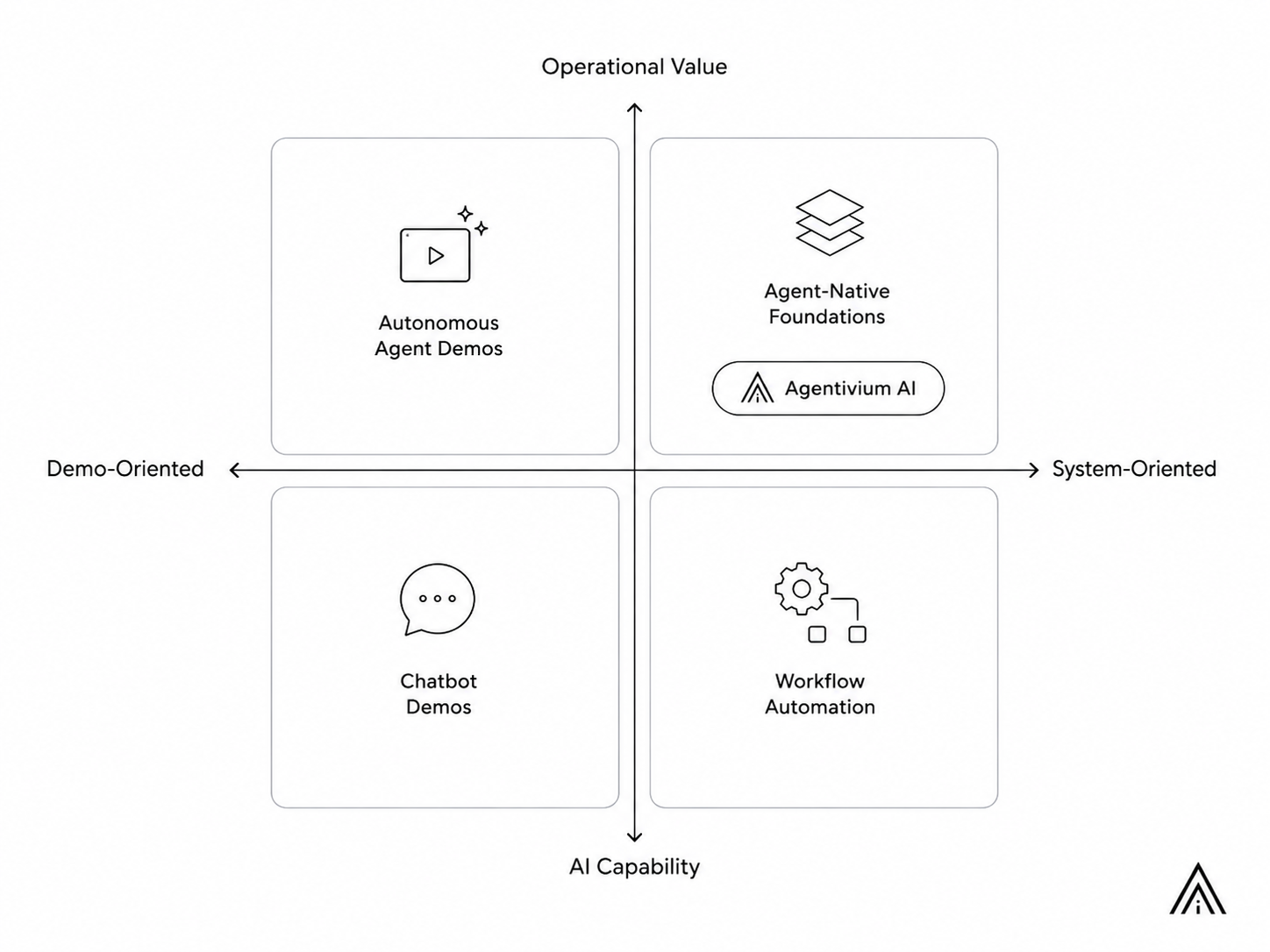
Agentivium AI sits in the system-oriented, operational-value quadrant—away from demo-driven hype.
For Students and Collaborators
For students, Agentivium AI is not only a place to learn how to use the latest AI tools. It is a place to learn how to think about AI systems seriously.
The important questions are not only:
- Can the agent answer?
- Can the agent call a tool?
- Can the agent automate a task?
The more important questions are:
- What state does the system maintain?
- What evidence supports the output?
- What action is allowed?
- What should be remembered or forgotten?
- What is the cost of this action?
- What should happen when the agent is uncertain?
- How do we know the system is improving?
- What reusable knowledge does this project contribute?
This way of thinking is slower than hype, but more durable.
Agentivium AI welcomes projects that begin from concrete domains. We care about education, agriculture, smart environments, HPC, and other real settings. But we care about them not as disconnected product ideas. We care about them as environments where agent-native systems can be tested, measured, and improved.
The ambition is not to predict a future where agents replace everything.
The ambition is to help build a future where humans and agents can work together through systems that are grounded, inspectable, constrained, resource-aware, and useful.
Closing Note
The question is no longer whether AI agents can produce impressive demos. They can.
The harder question is whether we can design systems where agents can be trusted, evaluated, constrained, and made useful over time.
Agentivium AI was created for that harder question.
We call this direction the agent-native frontier.
References and Further Reading
-
OpenAI. (2025, March 11). New tools for building agents. OpenAI Blog.
-
Anthropic. (2024, December 19). Building effective agents. Anthropic Engineering.
-
Microsoft. (2025, May 19). Microsoft Build 2025: The age of AI agents and building the open agentic web. The Official Microsoft Blog.
-
Google Cloud. (2026, April 21). Choose your agentic AI architecture components. Google Cloud Architecture Center.
-
IBM. (2024, July 3). What are AI agents?. IBM Think.
-
Sapkota, R., Roumeliotis, K. I., & Karkee, M. (2025, May 15). AI Agents vs. Agentic AI: A Conceptual Taxonomy, Applications and Challenges. arXiv:2505.10468.
-
Agashe, S., Han, J., Gan, S., Yang, J., Li, A., & Wang, X. E. (2024, October 10). Agent S: An Open Agentic Framework that Uses Computers Like a Human. arXiv:2410.08164.
-
Wang, N., et al. (2025, July 24). Efficient Agents: Building Effective Agents While Reducing Cost. arXiv:2508.02694.
-
Li, H., Zhang, H., & Hassan, A. E. (2025, July 20). The Rise of AI Teammates in Software Engineering (SE) 3.0: How Autonomous Coding Agents Are Reshaping Software Engineering. arXiv:2507.15003.